

Shelves Full Of Salt
Of What? From What?
It took me 13 years to get through 12 grade levels of public education. Yep, I had to do third grade twice, and even then I barely made it. In seventh grade, one of my teachers proclaimed that I would be left behind by success if, “you don’t apply yourself to your schoolwork.” I barely passed that year. By the time I reached my final year of school a couple of teachers raised my grades just enough to make sure I graduated. One of them told me privately “School is not for you.” Well, not that kind of schooling at least.
I hated school in every way, and for good reason. I was challenged with extraordinary hyperactivity, and clinically recognized dyslexia, particularly with numbers. Tests revealed that my short term memory, RAM memory if you will, was also terrible, so reading books, particularly fiction where I had to carry information forward, wasn’t rewarding.
My Grandmother, who I loved dearly, once wondered to my face “are you slow?” I knew what she meant.
I’m not slow. It turns out I’m autodidactic, a word I didn’t know until I turned 30. Once I escaped the prosaic confines of linear learning, I started reading a lot. I kept a readers journal, noting things I found interesting or challenging. I carried a dictionary with me everywhere. (A few years ago, I bought a 21 volume set of the Oxford English Dictionary.) I couldn’t stop reading, and since I was distractible, rather than reading one book at a time, I often had three or four going, so if I lost interest in one, I’d move to the other, and then back again. I still do that.
English was the one thing I loved, and because of my jumbled brain, math was the one thing I hated, at least until I discovered statistics. Statistics, I realized, was how to understand information logic and reasoning through numbers. I knew enough to know I didn’t know anything, but I kept looking.
That curiosity became essential after I was falsely accused in 2017, because in the wake of my arrest, people invested in the #MeToo upswell were touting rape statistics as a way of underscoring the size and scope of the challenges facing survivors of sexual violence, while others used them to “prove” that I was guilty of the crime, even after I was acquitted.
A former friend of mine posted on Facebook “you’re more likely to be struck by lightning, twice, than to be wrongfully accused.” You didn’t need much of an education in statistics to know that was terrible math. (If you’re curious, the chances of being struck twice, in a lifetime, is about 1 in 234 million) Sad but not surprising was how many people liked her statement. Such is motivated reasoning, the idea that you start with the answer you like, find and torture statistics you think support your conclusions, and present them as a fixed argument.
An example of motivated reasoning using a biased and sloppy reading of statistics appeared this week in an OpEd written in The Reporter, a tiny student run newspaper published by Mankato State University, which is located about an hour south of the Twin Cities.
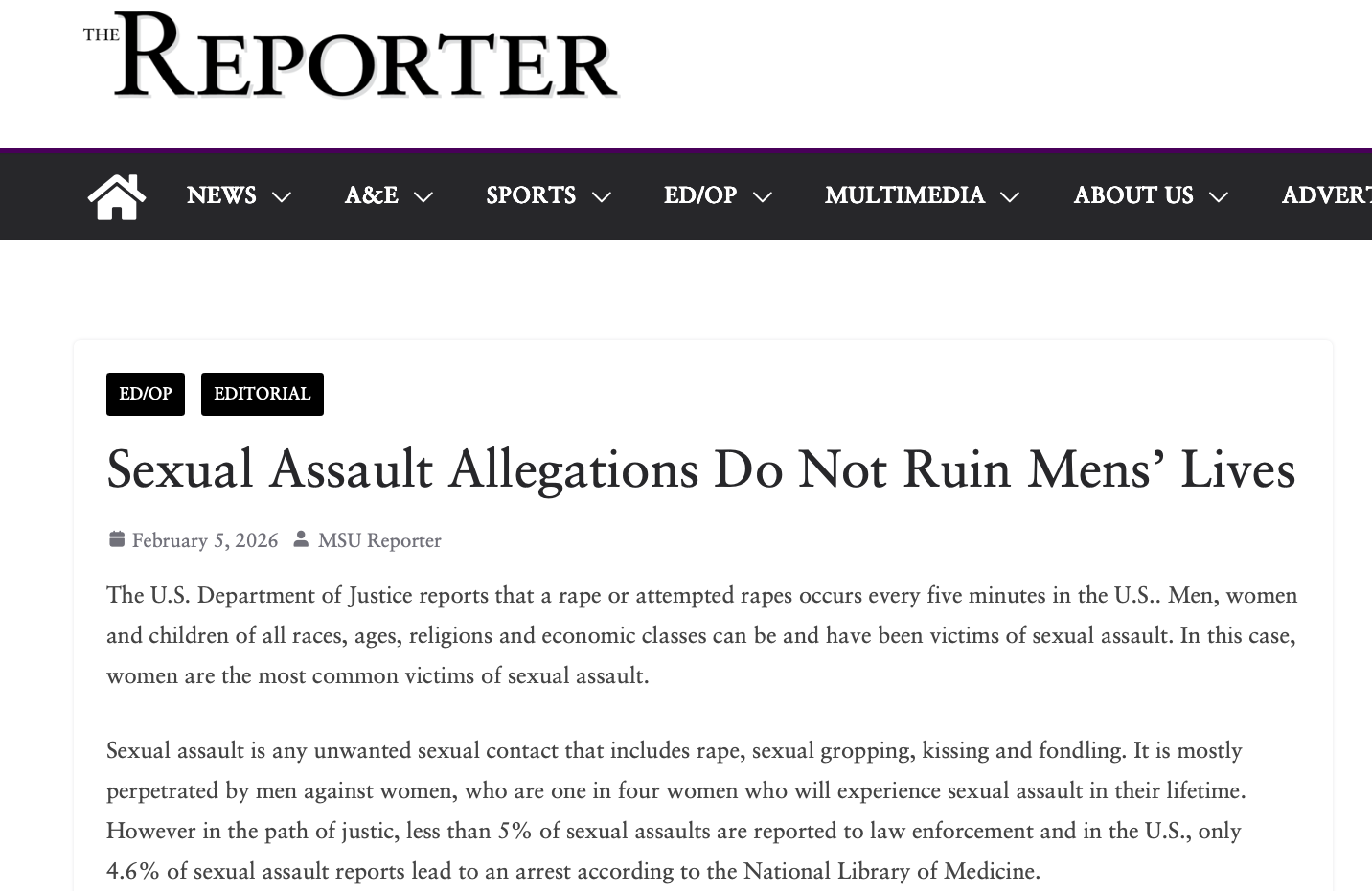
Let’s start with the headline:
“Sexual Assault Allegations Do Not Ruin Mens’ Lives.”
Oh really? This vapid statement obviously collides with the “lived experience” of men like me. By definition, my life, and many others have been ruined by wrongful accusations. Between my emotional collapse, months of serious depression and suicidal ideation, along with the costs of defending myself, and the catastrophic loss of my career, my retirement savings, 401K, and other investments have left my wife and me financially underwater without any retirement savings to speak of. Finding meaningful work as a writer, consultant, or even as a voice talent, is difficult or non-existent. That seems pretty ruinous to me, whoever you are.