


Apparently I’m a known predator. I’m a known, predator. That comma has a lot to say in describing me, or what you think about me. One is a label. The other, an accusation and a lie.
I bring this up because I came across some screenshots of comments posted online after my brief visit to the Renaissance Festival just about one year ago. I was there with Penn & Teller, who were celebrating their 50th reunion as a performing duo, which began at the festival, and where I met them. I’ve covered that in a previous podcast.
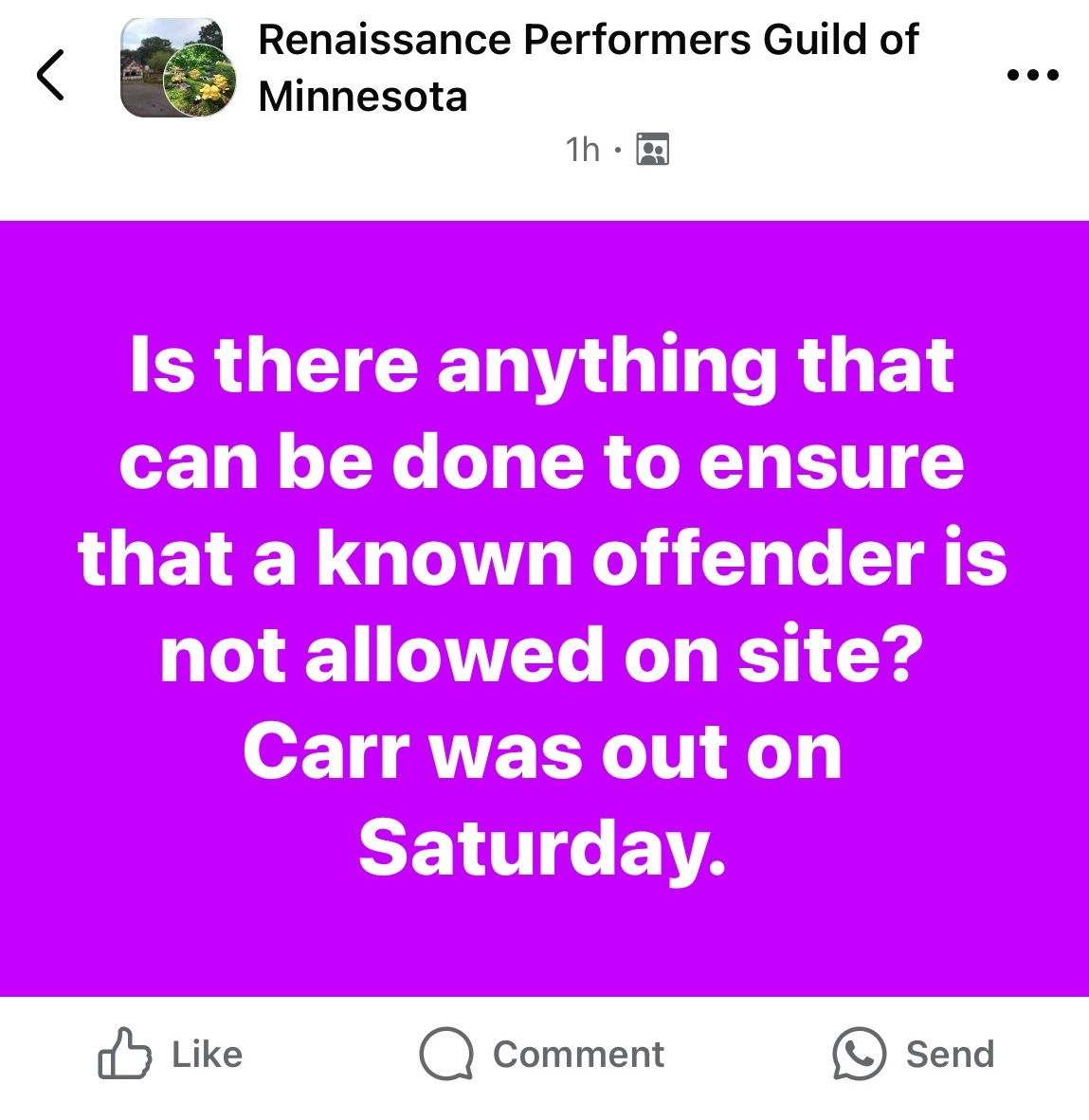
The post came from a performer at the show whose calling, as she sees it, is to exorcise or diminish any man at the festival, or in the world in general, she believes is a predator. Which, apparently, is most of them. Her position, that men are inherently oriented toward rape and violence against women, is a shibboleth among a certain strain of activist. Andrea Dworkin built a whole feminist philosophy in the 1970s around the idea that male violence against women isn’t just possible, it’s inevitable.
That word “inevitable” is doing a lot of work. We are far from resolved on the issues of sexual violence, rape and exploitation in this country. But the notion that it’s inevitable isn’t bound by evidence. It’s bound by belief.
I bristle at the idea that my allegedly predatory behavior was widely known, as if it was confirmed. By whom? It’s circular. The word “predator” gets used as an established fact that’s commonly known. No further questions need to be asked. Question the accusation and you’re branded ignorant, or assumed to be arguing in bad faith.
It’s not true. There is zero evidence to support the claim, and I’ve covered that at length. But under the rules of a moral panic, evidence and truth get sidelined for what you must believe.
The old definition of a moral panic assumed it was temporary. Something happens, a group gets frightened or outraged, certainty spikes, and eventually the fever breaks and life goes back to normal. That’s not what we have anymore. Politics today doesn’t cycle through panics. It runs on one continuously, just swapping out the target. There’s always a villain of the week, always a badge to wear, always a group whose certainty is the price of admission. The machinery never powers down long enough to be called an episode. It’s just the weather now.
That matters, because a temporary panic eventually corrects itself, people calm down, new information gets in, the group reassesses. A permanent one doesn’t have to correct, because it never stops long enough to be checked. Before one target is even fully discredited, the apparatus has already moved to the next name, and nobody circles back to update the record on the last one. The machine doesn’t need to be right about yesterday’s villain. It just needs a villain for today.
I got caught in a small, local version of something that, at a national level, has stopped being an aberration and become a permanent feature of how we argue with each other.
So how did my reputation flip in such a short window, with no real history of the behavior I was suddenly guilty of? The answer is simple. There wasn’t one. It was manufactured, and social media was the delivery system.
Here’s what that delivery system actually does. Before any of this, most people who knew me held some private, unremarkable opinion. Positive, mostly. Nobody had organized around it, because there was nothing to organize around. That’s just people going about their lives with a version of me in their heads that happened to be accurate.
A single hostile public post changes the physics of that. It doesn’t just add one more opinion into circulation. It converts private, scattered impressions into something visible, and once something is visible, it moves on its own. People don’t need to check whether it’s true. They only need to notice that others are already agitating, and decide whether to join in or get out of the way.
That’s the part that did the damage, not the accusation itself, but what happened once it was seen being seen. People who’d have shrugged off gossip in private suddenly had to reckon with a public position. Staying quiet started to look like taking a side. Screenshots got reposted, comments piled onto comments, and each new share felt like independent confirmation, when it was really the same claim, echoing. A handful of people pushed harder than the rest, reposting, prodding others to join, and the crowd behind them grew. Underneath the slogans and the moral language, the actual sentiment was cruder than any of it: fuck that guy, light him up. Forty years of a mostly positive reputation didn’t get argued down with evidence. It got buried under repetition dressed up as evidence.
To be clear, this isn’t persuasion. It’s performance. Nobody had to convince anyone I was guilty. They only had to make guilt look like something everyone already agreed on, and once it looked that way, jumping on the bandwagon required no evidence at all.
Nowhere is the mechanism clearer than Brett Kavanaugh’s confirmation hearing. Most of the country never read the testimony, never weighed the timeline, never sat with the specifics. They didn’t need to. Everyone around them already believed, or already didn’t, and that was enough. The hearing wasn’t really a fact-finding exercise for most of the people watching it. It was a referendum on which badge you were wearing, “I Believe Her,” “Believe Women,” Time’s Up. That’s the mechanism at national scale. What happened to me happened at festival scale, with the same parts.
We should all be wary of mechanics this simple, the rush to label and condemn that’s become so common. I didn’t believe Christine Blasey Ford, not because I thought she was lying, or insincere. Quite the opposite. Let me be precise. I didn’t believe the evidence was sufficient to convict. In many progressive circles, Kavanaugh is a known rapist. On the right, he’s simply innocent. Both sides are certain. Neither side is working from more evidence than the other. I believe he’s innocent. But I don’t know.
It never occurred to me that I’d end up on the wrong end of a #MeToo accusation, let alone one alleging rape. But the permission structure doesn’t just encourage accusation. It discourages the question. In 2017, more than a dozen women from the cast sent me screenshots and texts. They showed a small faction inside the performing community running on outright misandry. Several of those women had pushed back inside the group, only to be shunned or called rape apologists. Some left rather than keep fighting it.
Calling me a known predator means nothing outside that group, because it’s been disproven, repeatedly, to everyone but the people who never needed proof in the first place. Inside the group, it isn’t treated as belief anymore. It’s treated as settled fact, without ever needing evidence to become one.
The woman who called me a known predator isn’t unusual, and by her own colleagues’ account, not a popular figure. She found a pattern that she believed explained everything about men, power, predation, and then went looking for men to fit it. Once you have a pattern like that, you don’t need new evidence for each new case. You just need a name. The pattern does the rest.
This is also, if we’re honest about it, the basic architecture of conspiracy thinking. A conspiracy theory doesn’t fail because it lacks a mechanism. It has a mechanism, and the mechanism is airtight. Every new fact either confirms the theory or gets explained away as part of the cover-up. Point to condensation trailing off a wing at altitude and the true believer doesn’t see water vapor, he sees the proof he was looking for. There is no piece of evidence capable of disproving the theory, because the theory was built to survive contact with evidence. That’s not a coincidence. That’s the design. Conspiracy theories make dumb people feel smart, because they’ve discovered the secret, untied the knot, found the hidden pattern everyone else missed.
Her framework works the same way. Every man is either a confirmed predator or a predator who hasn’t been caught yet. My forty years without a single complaint isn’t evidence I’m not a predator. It’s evidence I’m good at hiding it, or that women were too afraid to come forward, or that the institution protected me. Whatever the story requires, the story provides. That’s the tell. A belief with an answer for every possible piece of counter-evidence isn’t a belief anymore. It’s a closed system. And closed systems don’t get corrected by facts, because they were never built to be falsifiable in the first place.
The people most certain they’d never fall for a conspiracy theory are often running one. They just don’t call it that, because the targets feel righteous instead of shameful. Nobody thinks of themselves as the guy with the corkboard and the red string. But structurally, that’s what she is. She has her string, and I’m the pin at the end of it. She isn’t looking at me. She’s looking at the shape she already believes in, and I happen to be standing where that shape needed filling.
It’s what makes moral panics durable instead of momentary. A liar knows she’s lying. She doesn’t. A lie requires knowing the truth and saying something else. She isn’t doing that. She’s saying what she’s certain is true. That’s the difference, and it’s the whole problem. Certainty doesn’t check its work. Only doubt does.
The women who reached out to me in 2017 understood this before I did. They watched the group harden around a belief that didn’t have to answer to facts anymore, and they tried to push back from inside it. Some of them told me directly that it felt crazy, like watching a room agree the world was flat. The world isn’t flat. But inside that group, flat was in fashion, and questioning it got you nowhere fast. Pushing back became socially expensive. Some of them left rather than keep paying that price. Dissenters become heretics, and heresy is expensive, so the group never corrects itself. It just gets smaller as people leave, and the ones who stay get more certain with every departure.
How do we solve for that? Evidence, where evidence exists. And where it doesn’t, the harder, less satisfying answer: we don’t know. That doesn’t mean throwing up our hands. Even without proof, we can weigh what’s actually there, a person’s history, the consistency of the story, the incentives at play, and arrive at an informed position. That’s different from certainty. It’s also different from nothing. It’s the position I hold on Kavanaugh: informed, not certain.
Here’s the test I’d apply to any of it. If someone is a known anything, the questions are simple. What do we know. How do we know it. If the only answer you can give is how strongly you believe it, sit down. There’s no reason to take your word for anything.
That comma I opened with, known, predator, one is a label, the other an accusation, didn’t survive the group very long. Give it a few weeks of repetition and the comma just disappears. Nobody types it anymore. It becomes known predator, no pause, no separation between what’s alleged and what’s true, because by then there’s no difference left to mark. The punctuation was the last place doubt could still live in the sentence, and doubt, as always, was the first thing the group got rid of.
That’s the whole story, really. Not what was done to me. What happened to a comma. A little mark that used to hold two different claims apart, evidence and belief, label and accusation, worn away by nothing more than people saying the same thing enough times that they forgot there used to be a pause there at all.
I’d like it back. Not for my sake. For the next name the machine picks.
Out Of The Blue podcast is listener supported, and is a stream of income that helps offset the deep debt I incurred when my livelihood was destroyed in the wake of a wrongful accusation. Please like episodes, comment and share. Every subscriber helps. Thank you.


