


Today in my Google Alerts is a story from Cleveland.com (The Plain Dealer) written by attorney Eric Foster, whose bio says he’s a lawyer in private practice from Atlanta, who has “tried 10 felony murder jury trials and argued more than two dozen felony appeals.”
The title sounded promising.
“False sexual assault allegations may be rare, but will that matter if you’re the one accused?”
It piqued my interest because grappling with the often complicated realities of false allegations is far too rare in modern media. These days, accusations of any kind of sexual violence or predation are a near automatic death sentence to the accused’s livelihood, community standing, and reputation and few people seem to care. In this piece, Foster doesn’t dismiss the wrongfully accused, but acknowledges as I do that most accusations are true. But most isn’t all, and my position is that these contradictions provide camouflage for media coverage to tar and feather the subjects long before there has been any evidence sorting, motions, or anything resembling a jury trial.
Foster starts off in the right direction, with a story about a high school friend, a basketball player he knew, who was wrongfully accused but “was later found innocent by a jury.” That’s the first flag. Mr. Foster is a lawyer with criminal trial experience so he should know there is no such verdict. The accused enters the courtroom presumed innocent. After considering the evidence and the witnesses, the jury finds defendants guilty or not guilty. Not guilty only means the prosecution failed to prove its case, and the defendant leaves the courtroom as they entered: innocent. That distinction is the entire architecture of due process, you can’t skip pass it.
Foster covers the usual dusty statistics on rape, citing that only 5.9% of accusations are false, so they’re rare. That figure comes from one study, one university, over ten years. More importantly, what’s the denominator of that 5.9%? It’s not hard to find. That study only counted cases where investigators affirmatively determined falsity, meaning she admitted to lying, or there was unimpeachable evidence she was elsewhere. Cases that were dropped, unresolved, or marked unsubstantiated don’t enter the false report column at all. Foster, like many others in the press, presents this as settled science. It isn’t.
He then mentions the famous 2% number, pulled from the musty closet of worn out data. As far as anyone can establish, it originated in a single speech in 1974 and has never been peer reviewed.
Whenever you see a rape statistic cited, ask what that data is standing on. What counted as a report? What counted as false? Who decided, and how? Strip that away and you don’t have useful data, just inference.
After citing these questionable statistics, Foster suggests that if 10 men were accused of sexual assault, at most only one of them would be falsely accused. That’s wrong. The number represents false reports out of reported cases. Not every accusation becomes a police report. Not every accused man is in that denominator. He’s applying a rate built from a narrow sample to a universe of accusations far larger than that sample ever captured.
Objection, counselor.
The math only works if you assume the only accusations that matter are the ones that reached police at a northeastern university between 1998 and 2007.
The Lisak study, which Foster’s statistics rest on, shows that 44.9% of those 136 cases were classified as “Case Did Not Proceed.” Unresolved. Not exonerated, not cleared, just gone. His claim that at most one in ten treats nearly half the data as if it doesn’t exist. (The Lisak study has been mostly denounced)
I’ll give the man a break because he’s not a statistician. Neither am I. But when my life was set on fire by the machinery of accusation, I got educated fast. We shouldn’t use a partial denominator to make a universal claim about accused men whose entire lives are in the balance. Rhetoric is not an argument. It’s the costume of one.
And finally, Foster closes with this:
“If, my fellow men, you need any further evidence of the frailty of our reasonable concern about false sexual assault allegations, consider this scenario: Your daughter or sister or mother comes to you claiming she was raped. Is your first instinct to doubt her? Or would it be to go find her rapist?”
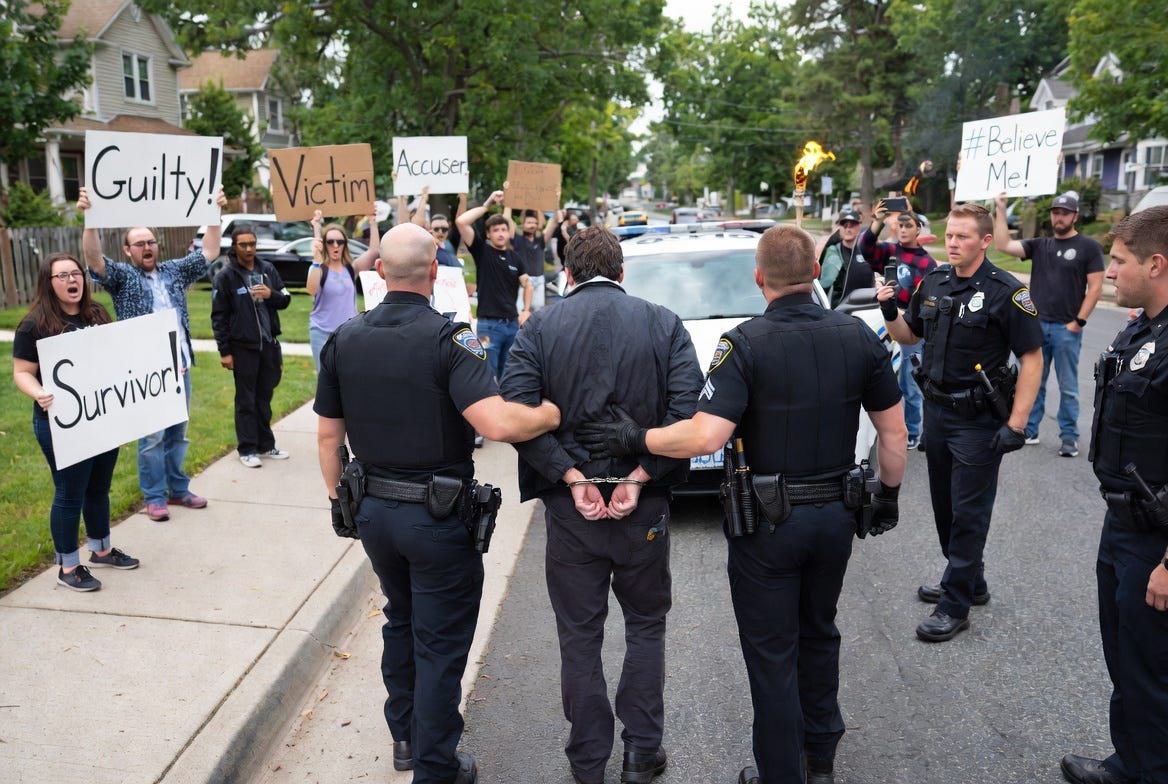
What he’s really saying is that these statistics, which he doesn’t fully understand, prove that false accusations are so rare that due process is an inconvenience. Follow that logic and my accuser could just as well have had me shot for what the statistics declared I must have done. This isn’t a stretch. After I was arrested the online rhetoric was terrifying. Statistics don’t just mislead. In the wrong hands, they become a noose.
I’d challenge Mr. Foster by turning his proclamation around. Your son, your husband, your brother is accused of rape. Is your first instinct to doubt him? Foster doesn’t answer that question. He never asks it.
There's a term from psychology; Perseverative Cognition. Repetitive, negative, circular thinking that's hard to disengage from. I have struggled with this myself. But I also see it in conversations about rape statistics, where numbers get cited, repeated ad infinitum, and we nod along. Round and round the numbers go, where they come from nobody knows! But few stop to ask what these numbers are standing on or where they came from, because asking would require taking your own argument seriously. After all, if a statistic is confirming your priors, you're less likely to argue with it.
Turns out, nearly 80% of trial lawyers who pass the bar can’t understand basic statistics. That’s a fact. I can’t prove it.
A note about this episode: I recognize that many of the statistics surrounding rape, even when imprecise or poorly sourced, point toward a real and serious problem. Rape remains too common. Many women never see their attacker brought to justice. Rape kits are still backlogged in far too many cities. False allegations are rare by comparison to all of that. My argument is not with those realities. My argument is with how we count, measure, and report the numbers we use to describe them. We have a long way to go on that too.
Eric Foster Opinion https://www.cleveland.com/opinion/2026/04/false-sexual-assault-allegations-may-be-rare-but-will-that-matter-if-youre-the-one-accused-eric-foster.html
The Lisak study (the 5.9% source) https://pubmed.ncbi.nlm.nih.gov/21164210/
The 44.9% “Case Did Not Proceed” problem / https://en.wikipedia.org/wiki/False_accusation_of_rape
The 2% origin, traced to Brownmiller and a judge’s casual remark The 2% figure appears in Susan Brownmiller’s book, but was refuted when it was revealed the statistic was based on a casual comment made by a judge at a bar association meeting. Ballard Brief Best source for this is the Center for Prosecutor Integrity piece and the Loyola Law Review article by Edward Greer: https://www.prosecutorintegrity.org/pr/one-third-of-sexual-assault-allegations-in-the-criminal-setting-are-unfounded-call-for-renewed-focus-on-fairness-and-due-process/https://digitalcommons.lmu.edu/cgi/viewcontent.cgi?article=2216&context=llr
The Slate piece / balanced, acknowledges the methodological mess from both directions https://slate.com/human-interest/2014/09/false-rape-accusations-why-must-we-pretend-they-never-happen.html


